What Is a Geared Motor and How Does It Work?

Time:2026-10-17 Author:Amelia
0%

A Geared Motor combines an electric motor with a gearbox, creating controlled torque for practical mechanical work. It appears in conveyor systems, automated doors, packaging machines, mixers, and mobile equipment. The motor supplies rotation. The gearbox changes that rotation into usable speed and force.

Austin Hughes, an engineer and author of Electric Motors and Drives, describes the basic function clearly: “The gearbox is used to reduce the speed and increase the torque.” That simple sentence explains the central advantage of a Geared Motor. A small motor can turn quickly, while the gear train delivers slower movement at the output shaft. Imagine a conveyor moving steadily under a heavy carton. The motor may spin rapidly inside the housing, but the gearbox helps the roller turn with greater mechanical strength.

Still, the explanation is not complete. Gear reduction can improve torque, but it also creates friction, heat, noise, and energy loss. Gear teeth may develop backlash. Bearings may wear when alignment is poor. Lubrication can also fail under excessive temperature or contamination. These details matter during selection and maintenance.

This article will examine how a Geared Motor works, including motor principles, gear ratios, torque conversion, efficiency, and common gearbox designs. It will also consider practical factors such as load cycles, mounting position, duty rating, and service conditions. Real applications rarely behave perfectly. That is why careful calculation should be combined with testing, inspection, and honest attention to operating conditions.
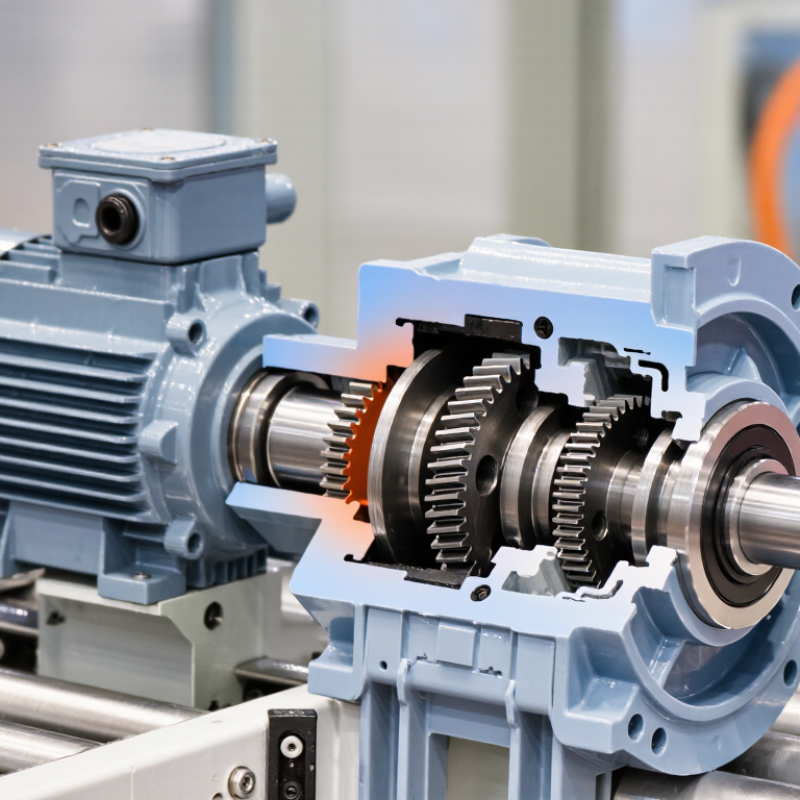
What Is a Geared Motor and How Does It Work?

What Is a Geared Motor?

A geared motor is an electric motor combined with a gearbox.

The motor creates rotation, while the gearbox changes its speed and torque. This arrangement allows a compact motor to handle heavier mechanical loads. In simple terms, the gearbox sacrifices speed to gain turning force.

That trade-off matters.

Inside the gearbox, several gears transfer motion from the motor shaft to the output shaft. Different gear sizes control the reduction ratio.

A higher ratio produces more torque and slower output movement. A lower ratio provides faster movement with less mechanical advantage.

The motor may use direct current or alternating current, depending on the equipment and control system.

In practical equipment, a geared motor can drive conveyor rollers, lifting mechanisms, adjustable tables, and small automated doors.

Engineers usually check rated torque, output speed, duty cycle, and mounting position before selecting one. Heat, vibration, and lubrication also affect service life.

A gearbox that looks strong may still fail under repeated shock loads.

That detail is easy to miss.

I once considered speed the main selection factor, but load changes often matter more. The motor must also start reliably under the connected load, not only spin freely during a bench test. Efficiency is useful, but it is never the only concern. Clearance, noise, and maintenance access can influence the final design.

What Are the Main Components of a Geared Motor?

A geared motor combines an electric motor with a gearbox to deliver controlled mechanical motion. The motor creates rotation, while the gearbox adjusts speed and increases usable torque. This arrangement suits conveyors, actuators, mixers, and automated equipment.

The motor is the driving component. It usually includes a stator, rotor, windings, and an output shaft. The gearbox contains several gears, often arranged in stages. Each gear stage reduces rotational speed and can multiply torque. Shafts transfer motion between the gears, while bearings support rotation and limit friction. Small details matter. Poor alignment can create noise, heat, and early wear.

A rigid housing keeps the gear train aligned and protects internal parts. Seals help retain lubricant and block dust or moisture. Grease or oil reduces contact friction, although the correct type depends on load, speed, temperature, and mounting position. Some geared motors also include an encoder, brake, or thermal sensor. These parts improve feedback, stopping control, and overload protection. In practical inspections, I check unusual vibration, oil leakage, and rising surface temperature. That assumption can fail: a quiet motor may still have damaged teeth. Gear tooth wear, loose fasteners, or incorrect lubrication may remain hidden during a brief test. Load measurements and maintenance records provide more reliable evidence.

How Does a Geared Motor Work Step by Step?

What Is a Geared Motor and How Does It Work?

How Does a Geared Motor Work Step by Step?

A geared motor combines an electric motor with a gearbox. The motor creates rotation, while the gears adjust its speed and torque. When power reaches the motor windings, magnetic force turns the rotor. The rotor then drives a small input gear. This part moves quickly, but it cannot produce much turning force alone.

The input gear engages larger gears inside the gearbox. Each gear connection reduces rotational speed and increases torque. The final shaft turns more slowly, yet it can move a heavier load. In practical testing, you can hear the motor start, feel the shaft accelerate, and observe a steady output speed. Lubrication reduces friction between gear teeth. Bearings support the shafts and help maintain alignment. The process sounds simple, but heat, vibration, and incorrect loads can reduce performance. A small error in gear alignment may create noticeable noise.

Tips: Check the rated voltage, output torque, and duty cycle before installation. Keep the gearbox clean and inspect unusual sounds early. Avoid forcing the output shaft by hand. That can damage internal teeth. Leave room for airflow around the motor. Measure actual operating temperature during extended use. Specifications help, but real conditions matter more. A motor may meet its rating on paper and still struggle with frequent starts, sudden loads, or poor mounting. Even experienced technicians should recheck these details.

What Is a Geared Motor and How Does It Work?

A geared motor combines an electric motor with a gear train. The gears reduce rotational speed and increase usable torque. This chart shows the calculated output for a 1,500 RPM motor producing 0.5 N·m of input torque, assuming 85% gearbox efficiency.

How it works step by step: The motor generates high-speed rotation, the gear train transfers motion through different-sized gears, the gear ratio reduces output speed, and the resulting mechanical advantage increases output torque. Higher gear ratios provide more torque but lower rotational speed.

What Types of Geared Motors Are Available?

What Is a Geared Motor and How Does It Work?

What Types of Geared Motors Are Available?

Geared motors combine an electric motor with a gearbox. The gearbox reduces speed and increases usable torque. The main types differ by gear design, efficiency, noise, and load capacity. Spur geared motors use straight teeth and offer simple, economical operation. They suit conveyors, small actuators, and light industrial equipment. Helical geared motors use angled teeth. They run more quietly and handle higher loads.

Bevel geared motors transfer power through a change in direction. They work well when the motor and driven shaft meet at an angle. Worm geared motors provide strong reduction in a compact housing. However, they can lose more energy through friction. Planetary geared motors deliver high torque from a small package. They often serve robotics, automation, and precision machinery. Cycloidal designs resist shock loads, although their construction can be more complex. No gearbox is perfect.

The International Energy Agency reports that electric motor systems consume nearly half of global electricity. That makes efficiency a serious selection factor. A market analysis from MarketsandMarkets also projects steady growth in the geared motor sector through 2028. These figures reflect expanding automation and energy-saving demand, not a reason to choose the most expensive design.

Tips: Check torque, output speed, duty cycle, noise, and mounting space. Do not size only by motor power. A worm gearbox may appear practical, yet heat can become a problem during continuous operation. Review the service factor carefully. Real loads are often less predictable than catalog examples.

What Is a Geared Motor and How Does It Work? — What Types of Geared Motors Are Available?

Comparison of common geared motor designs, operating principles, and typical applications
Geared Motor Type How It Works Typical Output Arrangement Typical Reduction Ratio Typical Efficiency Main Advantages Common Applications
Spur Geared Motor Uses straight-cut gears to transmit motor torque between parallel shafts. The gear ratio reduces speed while increasing output torque. Parallel or coaxial, depending on the gearbox layout Approximately 3:1 to 100:1 in multi-stage designs Approximately 80%–95%, depending on the number of stages and load Simple construction, compact size, low cost, and good mechanical efficiency at moderate speeds Small conveyors, actuators, instruments, vending equipment, and light-duty automation
Helical Geared Motor Uses angled teeth that engage gradually. This produces smoother and quieter power transmission than straight-cut gears. Usually parallel or coaxial; some configurations provide right-angle output Approximately 3:1 to 300:1, commonly using multiple stages Approximately 90%–97% for well-lubricated multi-stage units High load capacity, quiet operation, smooth running, and good continuous-duty performance Industrial conveyors, mixers, packaging machinery, pumps, fans, and material-handling systems
Bevel Geared Motor Uses bevel gears with intersecting tooth surfaces to change the direction of rotation, commonly by 90 degrees. Right-angle output Approximately 3:1 to 200:1, depending on the number of stages Approximately 85%–96% Changes the drive direction efficiently, supports substantial torque, and offers flexible installation Conveyors, lifting equipment, processing machines, and systems requiring a right-angle drive
Worm Geared Motor A worm screw meshes with a worm wheel. The sliding contact enables high reduction ratios in a compact right-angle housing. Right-angle output Approximately 5:1 to 100:1 in a single stage; higher ratios may use additional stages Approximately 50%–90%, depending strongly on the ratio, lubrication, and operating conditions Compact design, high reduction in one stage, quiet operation, and potential back-driving resistance at certain ratios Gates, hoists, conveyors, positioning systems, packaging equipment, and low-speed machinery
Planetary Geared Motor One or more planet gears revolve around a central sun gear inside an outer ring gear, sharing the load across several gear meshes. Usually coaxial; right-angle versions are also available Approximately 3:1 to 10,000:1 using multiple stages Approximately 90%–98% per stage, depending on design and load High torque density, high torsional stiffness, compact dimensions, and good load distribution Robotics, servo systems, machine tools, automation, medical equipment, and mobile machinery
Hypoid Geared Motor Uses offset spiral bevel gears. The offset permits a compact right-angle arrangement while maintaining smooth tooth engagement. Right-angle output with an offset shaft Approximately 5:1 to 200:1, depending on the stage configuration Approximately 85%–95% Quiet operation, high torque capacity, compact right-angle geometry, and smooth transmission Automated equipment, conveyors, transport systems, and machinery with limited installation space
How a geared motor works: An electric motor supplies high-speed rotation through its input shaft. Internal gears reduce the rotational speed according to the selected gear ratio and increase the available output torque. The actual speed, torque, efficiency, and allowable duty cycle depend on motor power, gear ratio, load, lubrication, temperature, and operating conditions.

Where Are Geared Motors Commonly Used?

A geared motor combines an electric motor with a gearbox to produce slower, stronger rotation. The gears reduce speed and increase torque. The motion feels deliberate. This makes the unit useful when equipment needs controlled movement rather than high-speed spinning.

Geared motors are common in conveyor systems, where rollers move boxes at a steady rate. Packaging machines use them to position bottles, seal containers, and advance labels. Automated doors rely on geared motors for smooth opening and closing.

Small versions also operate adjustable desks, vending mechanisms, and compact lifting devices. In agriculture, they help drive feeders, ventilation systems, and irrigation controls. Solar tracking equipment may use them to turn panels toward changing sunlight.

Choosing the right geared motor requires more than checking its power rating. Engineers examine load weight, operating speed, duty cycle, mounting position, and surrounding dust or moisture. A motor that performs well on a test bench may struggle under constant starts and stops. That detail is easy to overlook.

Gearboxes can also create noise, heat, and wear when poorly matched to the application. Regular inspection helps reveal loose couplings, unusual vibration, or lubricant problems. In real installations, modest torque reserves often improve reliability, although oversized motors can waste energy and space.

FAQS

What is a geared motor?

It combines an electric motor with a gearbox. The motor rotates, while gears reduce speed and increase output torque.

How does the gearbox ratio affect movement?

A higher ratio creates slower movement and greater torque. A lower ratio allows faster output with less mechanical advantage.

Where are geared motors commonly used?

They drive conveyor rollers, packaging equipment, adjustable tables, doors, feeders, and compact lifting devices. Motion stays controlled.

What should engineers check before selecting one?

Check rated torque, output speed, duty cycle, mounting position, and starting load. Space and maintenance access also matter.

Can the power rating alone confirm suitability?

No. Repeated starts, stops, shocks, and changing loads can cause trouble. A bench test may mislead.

What conditions affect service life?

Dust, moisture, heat, vibration, and poor lubrication can shorten service life. Inspect unusual noise and loose couplings.

Why is a torque reserve useful?

A modest torque reserve helps handle real load changes. Oversizing may waste energy and space.

Do geared motors always run quietly and efficiently?

Not always. Poor matching can create noise, heat, and wear. Efficiency matters, but clearance and access matter too.

What selection mistake is easy to make?

Focusing only on speed is common. Load changes often matter more, although this is easy to overlook.

How can maintenance problems be noticed early?

Listen for unusual vibration or noise. Check couplings and lubrication regularly. Small warnings can be missed.

Conclusion

A Geared Motor is an integrated drive system that combines an electric motor with a gearbox to deliver controlled speed, increased torque, and reliable mechanical power. Its main components typically include the motor, gear assembly, housing, shafts, bearings, seals, and connection terminals. Together, these parts transfer and regulate rotational energy, allowing the motor to operate efficiently under different load conditions.

The working process begins when electrical energy powers the motor, creating rotational motion. This motion enters the gearbox, where multiple gears adjust the output speed and multiply torque according to the gear ratio. Geared motors are available in several forms, including spur, helical, bevel, worm, and planetary designs, each suited to specific performance needs. They are commonly used in conveyors, automated equipment, robotics, packaging systems, medical devices, household appliances, and industrial machinery where compact, precise, and dependable motion control is required.

Amelia

Amelia

Amelia is a seasoned marketing professional with a wealth of expertise in our company’s core offerings. With an unwavering passion for driving growth and innovation, she plays a pivotal role in shaping our marketing strategies and enhancing brand visibility. A key aspect of her responsibilities......